Description
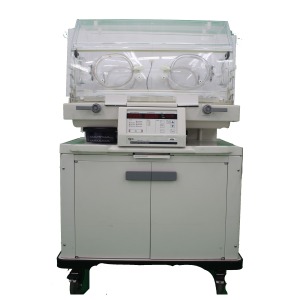
Veterinary ICU Incubator
GE Ohmeda Care Plus 4000
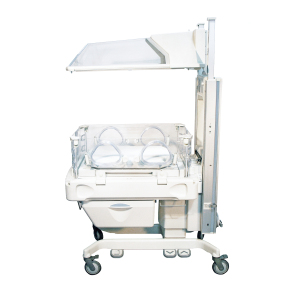
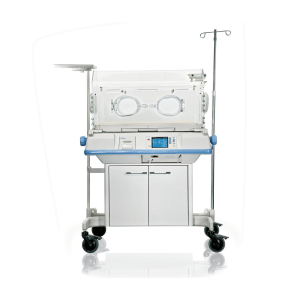
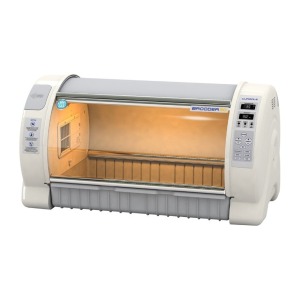
A closed, heated and humidified bed for neonatal puppies and kittens, birds, small exotics and other patients that cannot hold their own body temperature.
0 to 12°
Continuous bed tilt
95 to 98.6°F
Servo patient range
Up to 75%
Oxygen at 15 L/min
6
Port holes
Overview
The Care Plus 4000 is a microprocessor-controlled closed incubator from the GE Ohmeda line. In patient (servo) mode a skin probe drives heater output to hold 95 to 98.6°F (35 to 37°C). Air mode sets the hood from 68 to 98.6°F (20 to 37°C), and an override switch allows air settings up to 102.2°F (39°C).
In a veterinary hospital it gives a puppy fresh from a C-section, a chilled orphan or a debilitated bird a warm, humidified space that staff can watch without handling. Oxygen fed into the hood averages 25 to 45% at 5 L/min and 45 to 75% at 15 L/min, so a small patient can receive supplemental oxygen without a mask.
The controller runs self-test functions at power-up and during operation, and it monitors line voltage and adjusts heater output to compensate.
Key Features
Continuous tilt
Bed angle adjusts smoothly anywhere from 0 to 12°.
Servo and air modes
Skin-probe control from 95 to 98.6°F (35 to 37°C), or direct air control from 68 to 98.6°F (20 to 37°C).
Standard humidifier
Variable humidity from 10 to 75%, depending on room conditions and the temperature setting.
Oxygen into the hood
Average hood concentration of 35 to 65% at 10 L/min and 45 to 75% at 15 L/min.
Six port holes
Six port holes and six tubing ports, plus an 11 in (28 cm) access door.
Low air velocity
Average air velocity under 3.9 in/s (10 cm/s) with the inner wall, and temperature variability of 0.4°F (0.2°C).
Available options
- Stand: elevating base with 34 to 42 in (85 to 107 cm) mattress height, or cabinet
- Drawer package: single deep drawer or dual drawer, for elevating base or stationary pedestal
- Hood: active double wall
Veterinary Applications
Small-animal and exotic hospitals use closed incubators wherever a patient needs steady warmth, humidity or oxygen with minimal handling.
- Neonatal puppies and kittens after C-section or dystocia
- Hypothermic, orphaned or fading neonates
- Supplemental oxygen for small dyspneic patients
- Debilitated or dyspneic birds
- Exotic small mammals in anesthetic recovery
- Hands-off observation of stressed or fragile patients